

PAN
The term PAN comes from panoraming (パノラミング), meaning a panoramic camera movement across a scene. In Japanese animation, it indicates the horizontal or vertical movement of the camera and appears as a standard notation in both timesheets and timecharts. A PAN can follow a character in motion, reveal new scenery, or create a specific emotional rhythm.
There is different type of PAN:
- PAN R (pan right)
- PAN L (pan left)
- PAN UP
- PAN DOWN
Timesheet
In the timesheet, PAN is written in the camera instruction column. You can see some variations as below:
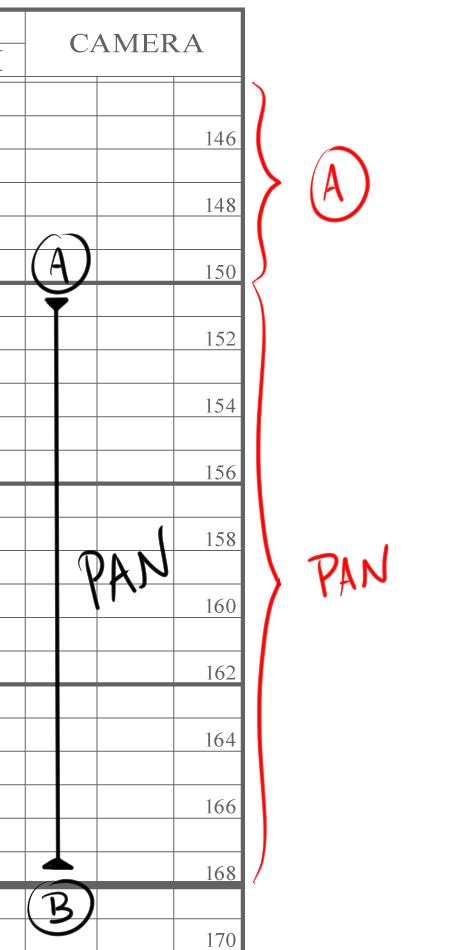
On the camera instruction before A, it is only A camera. After B, it stays as B.
In the Memo field, you may enter:
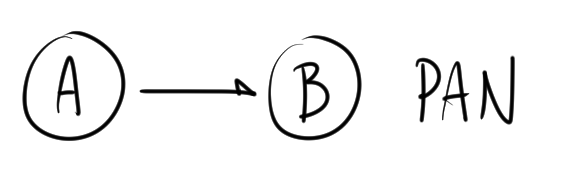
This ensures the camera movement is synchronized with the timing of the scene.
Timechart
In the timechart, PAN is represented by a simple frame graph showing start and end points marked with letters. Even spacing indicates a linear movement, while compressed or expanded intervals create acceleration or deceleration effects. This allows the animator to visually control the rhythm of the pan.
The notation is specifically using colorful frame with letter to follow the movement:
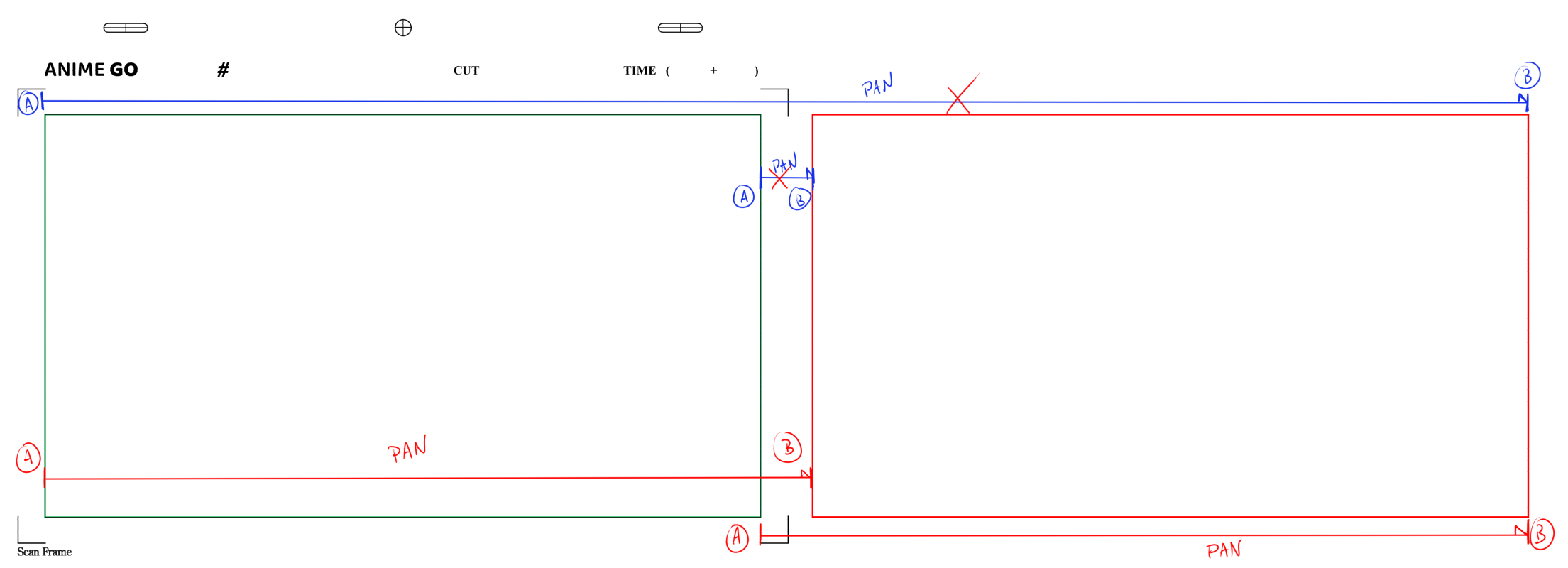
As you can see in the image above, the blue markings are incorrect. The PAN movement must always be indicated from the same reference point of the camera. For example, starting from the left edge of Camera A and extending to the left edge of Camera B.
Variations of PAN often appear in Japanese production notes:
- QPAN (Quick Pan): a sudden and fast pan.
- FLASH PAN (フラッシュ PAN): extremely rapid, producing a blur or transition effect.
- ROUGH PAN (フラ PAN): a simplified draft pan used in layouts.
- EXPRESS PAN (急行 PAN): a more dynamic, expressive camera movement.
- SLIP PAN (スリップ PAN): a sliding movement that mimics a cut.
In production, PAN instructions should always be clearly marked on both the timesheet and the timechart. The timesheet gives the direction and frame count, while the timechart shows the timing visually.